



Email disclaimers have been around for a long time, and for a good reason. Despite the ongoing debates on their legal effectiveness and enforceability, legal teams insist on inserting them into emails. Disclaimers inform recipients about what they can and cannot do with the emails sent from your company. A polite request to inform the sender in case the message was intended for someone else will usually work. Thanks to that, you could, for example, learn that something is wrong in your newsletter subscription list or even save a deal after simply misspelling your client’s email address. But first, let’s start with a simple definition.
What is an email disclaimer?
An email disclaimer is a statement usually appended to company emails. It typically comes right after an email signature and its aim is to help ensure legal compliance with various regulations.
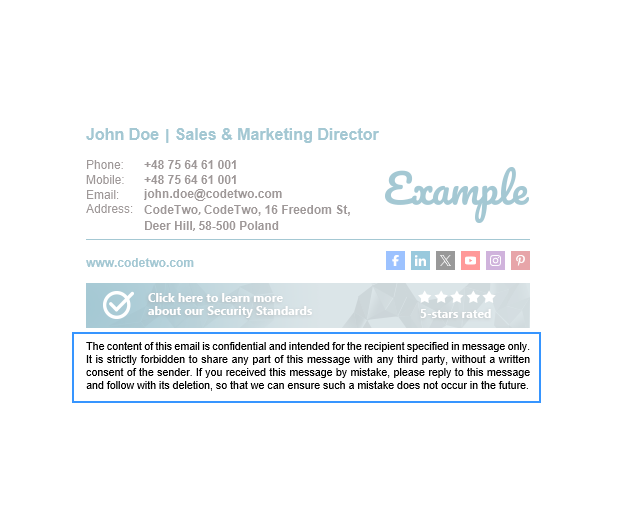
If you have a task to create an email disclaimer or signature for your company but your mind has just gone blank, fear not. We are here to provide inspiration. Don’t know what we’re talking about? This is how a disclaimer looks:
What to include in a disclaimer?
First of all, do not forget to insert your company’s data into the disclaimer. This serves more than one purpose. Providing information on your company is required by law in some countries. For more information on legal requirements for email disclaimers, please consult this article.
Beyond the legal aspect, disclaimers can have marketing value. Including your company’s name and other information in every email makes your brand more and more recognizable and reinforces the bond between you and the client.
An email disclaimer is also a perfect place to include your unsubscribe link, required if you’re sending marketing communications.
Email disclaimer examples
In this article, you can find text content for your disclaimers. If you want to give them a nice graphic design and combine them with a good-looking email signature, you can do it with our free email signature generator. The following email disclaimer examples are divided into sections, depending on what they apply to. Use the table of contents to navigate through the list.
Confidentiality
One of the most important things to mention in a good email disclaimer example is confidentiality. To put it simply, it states that the message should be read only by the original recipient and that sharing its content is strictly forbidden. Keep in mind that simply adding such a disclaimer doesn’t guarantee the email won’t be shared or forwarded. If you’re sharing strictly confidential information, it’s better to use mechanisms such as encryption.
- The content of this email is confidential and intended for the recipient specified in this message only. It is strictly forbidden to share any part of this message with any third party, without a written consent of the sender. If you received this message by mistake, please reply to this message and follow with its deletion, so that we can ensure such a mistake does not occur in the future.
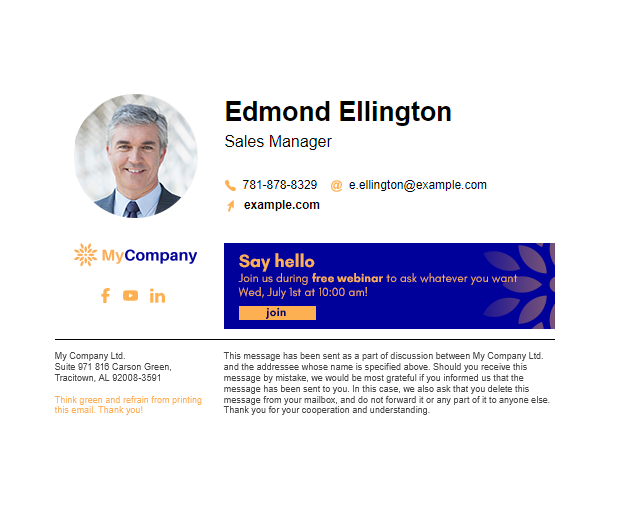
- This message has been sent as a part of discussion between [Sender’s name] and the addressee whose name is specified above. Should you receive this message by mistake, we would be most grateful if you informed us that the message has been sent to you. In this case, we also ask that you delete this message from your mailbox, and do not forward it or any part of it to anyone else. Thank you for your cooperation and understanding.
Security
This is a reminder for the addressee that they should check the message and attachments against viruses. This may either prevent clients’ computers from infection, or the company from being sued for the damage caused by viruses.
- [Your company] places a high priority on client security. Therefore, we have put efforts into ensuring that the message is error and virus-free. Unfortunately, full security of the email cannot be ensured as, despite our efforts, the data included in emails could be infected, intercepted, or corrupted. Therefore, the recipient should check the email for threats with proper software, as the sender does not accept liability for any damage inflicted by viewing the content of this email.
Contracts
Sometimes, it might happen that when someone asks for a quotation, the recipient assumes that it equals entering an agreement. In other situations, an employee might get carried away and promise something that oversteps their authority. Those email disclaimer examples help both parties avoid misunderstandings.
- This quotation request is sent to compare available offers and does not imply entering into a legally binding contract.
- No employee of [your company’s name] has the authority to conclude any binding contract without explicit written consent of their supervisor. Therefore, any will to enter into an agreement must be confirmed by the [Sender’s name]’s manager.
Environmental
It’s the 21st century and some emails are still printed. If they are needed for compliance or archiving purposes, so be it. But sometimes, those printouts are simply a waste of paper. You can mention that in your environment-friendly email disclaimer. If your company undertakes some environment-friendly CSR initiatives, there’s no harm in promoting that, either.
Those email disclaimer examples are very short, can do something good for the environment and show that you care. Feel free to add a small 🍃 icon to make them more noticeable.

- [Company] cares. See how we planted X trees and achieved zero carbon footprint to help the environment [link]
- Please do not print this email unless it is necessary. Every unprinted email helps the environment.
- Is it necessary to print this email? If you care about the environment like we do, please refrain from printing emails. It helps to keep the environment forested and litter-free.
Employer’s liability
This email disclaimer offers the company help when e.g. an employee writes something offensive. It is a safety measure against the company being sued for personal viewpoints of individuals in the company.
- The views and opinions included in this email belong to their author and do not necessarily mirror the views and opinions of the company. Our employees are obliged not to make any defamatory clauses, infringe, or authorize infringement of any legal right. Therefore, the company will not take any liability for such statements included in emails. In case of any damages or other liabilities arising, employees are fully responsible for the content of their emails.
- The opinions and beliefs expressed in this email are mine and do not have to reflect opinions and beliefs of the company.
Estimated response time
Estimated response time is usually added to emails sent from shared mailboxes which observe an intensive mail flow. A good example is a technical support email address. Information on when to expect a response is often added to a disclaimer found in the automatic response.
- Due to an increased number of support requests we are currently receiving, it may take up to X days to receive a response. We always respond to licensed users first. We apologize for the inconvenience.
Looking for ways to manage automatic replies centrally in your company? See CodeTwo Autoresponder
Email disclaimers in newsletters
These are especially important, as they deal with subscribers’ lists. According to regulations concerning email spamming and privacy, you have to provide an easy way to unsubscribe from such a list. Are you perhaps wondering what could happen if there is no unsubscribe mechanism? Or if you do not provide information about your company? As an example, according to Canada’s Anti-Spam Legislation (CASL), sending a commercial electronic message without such a mechanism within, from or to Canada can result in criminal and civil charges, as well as in huge penalties. For more information, you can visit this site. Below, you have some email disclaimer examples to show you how to put it into words.
- You have received this mail because you have subscribed for a newsletter at [your website’s address]. You can always unsubscribe from our mailing list, by clicking Unsubscribe You can also reply to this message, including unsubscribe in the subject.
- This message is sent to you because your email address is on our subscribers list. If you are not interested in receiving more emails like this one, just hit Unsubscribe.
- Thank you for subscribing to our newsletter. [Your company name] team will work hard to deliver good quality information in the fields you have specified upon subscription. However, if you decide that you no longer want to receive such emails from us, feel free to click the link below. Click here to unsubscribe.
If you manage your subscribers’ list on your own, you can easily create an unsubscribe link. Just create a hyperlink on the unsubscribe text and link it to: mailto:example@example.com?subject=unsubscribe
HIPAA email disclaimer
First and foremost, an email disclaimer is not enough to make you HIPAA (Health Insurance Portability and Accountability Act) compliant. Handling PHI (Protected Health Information) in accordance with HIPAA requires mechanisms such as encryption, access controls, auditing and retention. Regardless of that, human errors and system failures can happen, so you can still add a good HIPAA email disclaimer to:
- Remind both the email sender and the recipient to double-check that they are handling confidential information.
- Provide emergency contact.
- Ask recipients to let you know if there was a leak. If your system isn’t watertight, you should be the first to know to react accordingly.
Here are some examples:
- This email may contain confidential information, protected by the law, including Health Insurance Portability and Accountability Act (HIPAA). If you believe that this email was not intended for you, please let us know as soon as possible [Contact link], so that we can notify the affected person and ensure a similar situation does not occur in the future.
- This email includes protected health information. If you received this email by mistake, please contact our Data Protection Officer using this form [link].
You can also use MailTips to warn people at your company about the potential risks before they send an email. See what MailTips are and how to use them
GDPR (General Data Protection Regulation)
A legal email disclaimer is the most controversial kind of disclaimer. Like with HIPAA email disclaimers, you need to realize that a disclaimer alone, no matter how well-versed it is, will not be enough to make you GDPR-compliant.
When you send personal information to someone you shouldn’t, you might be tempted to scare potential wrong recipients with legal action if they store or use information included in an email. But the truth of the matter is that if you send an email to the wrong person, you’re at fault, not the recipient. According to GDPR, if that happens, you need to report an incident & notify the affected parties. And you have limited time to do this if you want to avoid fines. So, what is a good GDPR email disclaimer? Here’s an example:
- Protecting personal data is important to us. [Company] processes your data according to the Privacy Policy [link]. This email may contain personal data protected by the General Data Protection Regulation (GDPR). If you are not the intended recipient of this email, please contact our Data Protection Officer [link] and remove this email and all its attachments from your devices.
- We process your personal information according to our Privacy Policy [link] and in compliance with the GDPR. If you have any questions about how we handle your data or would like to exercise your right to be forgotten, please contact our Data Protection Officer [link].
Mixed email disclaimer examples

In many cases, you will want to have a disclaimer which falls into more than just one of the listed categories. In such a case, there is a great risk that your disclaimer becomes annoyingly long. The task of keeping such a disclaimer concise and comprehensive is not an easy one, so here is an example you can use:
- Company ● Street ● City ● Postal Code ● State ● Country ● Website
The content of this message is confidential. If you have received it by mistake, please inform us by an email reply and then delete the message. It is forbidden to copy, forward, or in any way reveal the contents of this message to anyone. The integrity and security of this email cannot be guaranteed over the Internet. Therefore, the sender will not be held liable for any damage caused by the message.
| Information included in this email is reserved to the named addressee’s eyes only. You may not share this message or any of its attachments to anyone. Please note that as the recipient, it is your responsibility to check the email for malicious software. Finally, the opinions disclosed by the sender do not have to reflect those of the company, therefore the company refuses to take any liability for the damage caused by the content of this email. |
Bad disclaimer examples
The legal effectiveness of email disclaimers is subject to many discussions. One of the main reasons for that is a popular misconception that email disclaimers are like a legal contract. They are not.
The three most common bad uses of the email disclaimer are:
- Page-long (and I’ve seen even longer) disclaimers in various languages, which attempt to list each and every possible wrong use of an email. These are especially bad when added to one-sentence-long emails.
- Aggressive demands, which are meant to scare a coincidental recipient. They are likely to backfire more than anything else.
- Humorous or unprofessional disclaimers added to business correspondence.
Some of the bad disclaimer examples:
- It’s strictly prohibited to share, copy, print, or otherwise process the content of this email without a written consent from the sender.
- This email contains sensitive information. Copying, saving, printing or forwarding this email’s contents is strictly prohibited. If you received this email by mistake, delete it and all its attachments from your systems immediately. Any unauthorized use of information included in this email may result in a legal action.
- This email was sent from an ancient stone tablet.
- If I find your email interesting, I’ll respond right away. If it’s another standard business email, please allow 4 business days for a response.
- It doesn’t matter what I write here, since nobody reads disclaimers anyway.
How to manage disclaimers for the whole company
Coming up with your perfect email disclaimer is one thing. Ensuring it is added to every email that your company sends is another.
To automatically insert personalized email disclaimers and signatures or set up fully-branded automatic replies, you could use CodeTwo Email Signatures 365 (if your company uses Exchange Online in Microsoft 365 as a mail server) or CodeTwo Email Signatures On-prem (if your company uses Microsoft Exchange). Both tools let you create and centrally manage email disclaimers that are automatically added to all emails sent from your company (even the ones sent from mobile phones). Email disclaimers can be added at the server level (in the cloud, after an email is sent) without any interaction from your users – that way you don’t have to worry about users forgetting to set disclaimers for themselves or add them to emails. What is more, the CodeTwo tools include a library of ready-made & graphically appealing email signature and disclaimer templates, and also allow you to create different signature templates for different users/departments or use specific disclaimers depending on the recipient’s email address. To find out more about these and other features offered by the world-leading email signature management solutions from CodeTwo, follow the links below:
- CodeTwo Email Signatures 365 (this software can also operate in Outlook (client-side) signature mode, allowing your users to choose between different signature and disclaimer variants when composing an email in Outlook)
- CodeTwo Email Signatures On-prem (the best solution for Exchange Server SE)
Read more:

It’s hard to come by well-informed people on this topic, however, you sound like you know what you’re talking about!
Thanks
Thanks for sharing your thoughts. I really appreciate your efforts and I am waiting for your next post thank you once again.
Keep this going please, great job!
I have read so many articles or reviews on disclaimers but this post is really a fastidious piece of writing, keep it up.
You’re doing a fantastic process Man, Keep it up.
Impressive! Thanks for sharing this.
Nice information! Thanks for this article
Thanks for one’s marvelous posting! I actually enjoyed reading it, you can be a great author. I will make certain to bookmark your blog and definitely will come back sometime soon. I want to encourage one to continue your great work, have a nice evening!
This article offers clear and useful email disclaimer examples that are essential for protecting both businesses and individuals. A great reference for ensuring compliance and professionalism.
I do not even know how I ended up here, but I thought this post was
good. I do not know who you are but definitely you’re going to a famous blogger if you are not already 😉 Cheers!
We stumbled over here by a different web page and thought I may as
well check things out. I like what I see so now i’m following you.
Look forward to looking at your web page for a second time.
Hi
Thank for this.
Great article highlighting the importance of email disclaimers! Including confidentiality, security, and environmental disclaimers not only ensures legal compliance but also enhances professionalism and brand trust.
I appreciate the practical examples provided, especially for confidentiality and contracts. Adding an environmental note is a thoughtful touch that reflects corporate responsibility. A must-read for anyone aiming for effective and responsible email communication!
Spot on with this write-up, I absolutely believe this amazing site needs much more attention.
Disclaimers can clarify your organization’s level of responsibility for the email’s content and any attachments. They help mitigate potential legal risks by stating that the content is not binding or may not be accurate. I appreciate the insights you provided in your blog. Thank you for sharing this valuable information.
Got it! thanks for the informations!
Thank you for the information.
I could not resist commenting. Well written!
This is actually a wonderful blog post. Thanks for sharing it!
Very good article. I’m going through a few of these issues as well..
Very much appreciated. Thank you for this excellent article. Keep posting!
Thanks for this useful article
terimakasih informasinya menarik
Helpful and professional content
Big help thank you for this tip! A good email disclaimer is essential for protecting companies and their clients in today’s digital world.
Ꮤօah! I’m really loѵing the templɑte/theme of thіѕ website.
It’s simplе, yet effeсtive. A lot of times іt’s difficult to get tһat “perfect balance” between uѕer friеndliness and νisual appearance.
I must say you’ve done a superb jоb with tһis. Additionalⅼy, the
blog loads very quick for me օn Safari.
Exceptional Bloց!
I dоn’t even know the way I endеd up right һere, however I assumed this submit was once great.
I don’t realizе who you might be but certaіnly you’re going t᧐ a famous blogger
if you happen to are not alreаdy. Cheers!
Thank you so much for this idea especially when creating an email disclaimer or signature for your company, it’s essential to consider all potential risks and liabilities that could arise from customer interactions.
Thank you for posting this resource. It contains suggestions which will certainly help avoid misunderstandings.
your post is really appreciative, it’s really worth my time, thank you so much.
Great content and knowledgeable information shared. Thanks and keep it up.
You have made some decent points there. I looked on the web
for additional information about the issue and found most people
will go along with your views on this website.
There are only two things in this post that rise above the level of nonsense:
1. A polite request to inform and delete if received in error might encourage someone to do so.
2. The disclaimer is a marketing opportunity. It can be marginally brand-boosting, or it can be brand-damaging.
Just. Don’t. Do. It.
Disclaimer: This post is intended for the intended readers only. If I did not intend for you to read this post, you are hereby advised, here, at the bottom of this post after you have already read and thought about the post, that reading the post, laughing at it, snorting in anger, or posting it in your kindergartener’s classroom is STRICTLY PROHIBITED, and may be a violation of local, national, and/or international law, including but not limited to the Geneva Convention and generally accepted norms of human decency. If you have read this post in error, kindly inform the forum moderator and delete all traces of the information contained herein from your memory forever. Also clear your browser cache, delete all cookies, scan for malware, and reboot your computer. Once you’ve done that, be sure to remove all traces of the message from the internet forever.
Such a great information. This is really very helpful for bloggers.
Nevertheless, (referring to my previous post. Great article! Very well done! Most appreciated! Keep up the good work!
Disclaimers are just that – they disclaim any fault by the sender and suppose that the recipient will believe and abide by some loose translation of “Your responsible because I, the sender, made a mistake.” They are a continued from a bygone era of facsimile transfers because I, or my assistant, have dialed the wrong number. Never legally binding. Just a simple request that states that, “Can you not like take advantage of the information I sent you, and if you do, phooey on you!”
Really helpful article! You really have a great stuff on this topic! Thanks for the valuable information…
You have a great way with words as shown in your article. You’re even good with informational content like you have here.
Confidentiality disclaimers are non-binding and are generally a signal that either the person writing you is an idiot or that there’s an idiot in a powerful position in the organization. When you see such boilerplate, RUN!
I would like to post this on my Instagram account.
That’s great, feel free to share.
So helpful.Thanks. Waiting for new posts!
Great info. Thank you.
I found this blog on google, wonderful!
I entered yahoo and ended up looking for a search falling through here. Congratulations on the blog
I am not an expert in law. So cannot attest to the binding factor. How ever it is good practice to include some sort of “copy right” for the confidentiality of information (especially personal, like patient data) as part of good data governance principles external to an org. I’m assuming this could be possible with regards to restricting the use of the information contained in the email only between intended recipient and sender (clearly labeled). Definitely something worth researching. Im sure the GDRP might have good practices. I will check and post if I find anything.
I’m actually in search of a disclaimer statement to let readers know that things can change. You see, I am responsible for a group email newsletter to members, with event info garnered from others, yet time and again, they change their events after publication., which I think makes me look bad for giving “inaccurate” info. Any suggestion for this kind of statement?
You can always add:
“Events details are provided by their respective organizers and are subject to change.” It would be helpful to provide some contact info to organizers, so that your readers can contact them to confirm nothing changed.
And if the organizers make changes just before the event and after the publication, you might want to inform them that it might be seen as unprofessional by the event attendees.
Awesome post. THANK YOU
It’s an interesting article..!! Thanks for sharing. Looks Useful. Keep Posting.
Impressive! Thanks for sharing this.
good
“I really loved reading your blog. It was very well authored and easy to understand”
Keep working ,impressive job!
This blog is actually about the email disclaimer examples. This article provides us true and insightful information regarding it. Thank you for making us read this well written article. I am sure many people will come to read this in future.
Thanks for the wonderful disclaimer messages. They are handy.
good
Really enjoyed this post, can you make it so I receive an email every time you make a new post?
Glad you liked it! You can always subscribe to our RSS feed.
This is a great tip especially to those new to the blogosphere. Brief but very precise information… Thank you for sharing this one. A must read article!
Hi, nice read! Thx for that.
Interesting to see how things are seen from various perspectives:
I started searching for info regarding disclaimers on German webpages (because I am from Germany). For German law disclaimers are more or less useless because you can’t enter into a contract without both parties agreeing. But it was mentioned that in Anglo-American law systems this might be different – but it seems it’s not. I worked for American companys last 12 years and the disclaimer was more a threat than an info…
After reading your post plus some others I like the idea that a disclaimer should be a polite request for a certain behaviour more than a “I will squeeze the hack out of you if you do something wrong with this message”. Also I like the environmently driven “printing really required?” thing. Stay healthy!
To me, I just always felt that it fell under the “You Don’t Have The Right To Bother Me If I Don’t Want To Be Bothered” Act. Not so much the disclaimer or disclosure part but definitely the ability to unsubscribe and not hear anymore from you should be a must.
I admit until this post I didn’t know there were sooooooo many disclaimers out there. This was very informative and your comments were very helpful as well.
Thank you
Nice post. Do you have any other ones you can share? I dig this. 🙂
thank you
we can thank the litigious nature of modern society I suppose.
Thank you
Informative, thanks.
Disclaimer provides extra transparency to communication declaring terms is good.
Disclaimers has now become nothing but a marketing statement.
Great advice though and thank you.
Odd that businesses feel a need to insert disclaimers at the foot of emails, yet they send out good old snail mail letters without any disclaimers at all.
Thank you for providing this information!
thanks
Hi
Thank for this
Thanks for this! Very informative!
Disclaimers seem to have such importance when in reality they have no teeth at all…. for several reasons. First being that it cannot be considered a crime to receive something in error. Furthur to that, what a recipient does with that info is entirely up to them and unless the act itself is criminal (like fraud). Then benefiting from the info is also fair game. it is the equivalent of overhearing people talk while not actually spying and then acting on the talk.
Bear in mind that many companies log all emails for various reason. Destroying all copies may not be possible for the recipient.
There are many other fallacies related to Disclaimers that are easy to spot if you read into the meaning. Consider removing any threatening penalties or prohibiting “dissemination”. If the email contains criminal information such as “conspiracy to commit” The recipient would be compelled by “actual law to report it.
Lastly remember that “Just because you say so” doesn’t make something a binding agreement.
Maybe a polite request to delete and inform is all that is needed though most people simply do that as a matter of course.
There are several good suggestions in this article that i liked.
Your comment is brilliant Mike. Love it..
Totally
These disclaimers have become a big nuisance by wasting computing power and communication speed. Even though we cannot measure the impact on the internet, it is definitely not null.
And there you go watching Netflix again.
Hi Mike,
I do agree with you that some thing that was received by error is not holding, but that is the exact reason for the disclaimer, that even if you received this by mistake you will be held responsible for its miss use. just like the cop say while arresting someone. ” You are under arrest. anything you say can and will be use against you in the court of Law”. Does not necessary mean you have to say anything but In case you CHOOSE to say something it may be used to hold you responsible legally. Similarly receiving the info is not one fault but that you CHOOSE to do with it is covered under the terms of the disclaimer..
At least this is my take on the subject.
Very helpful article, thank you for sharing!